





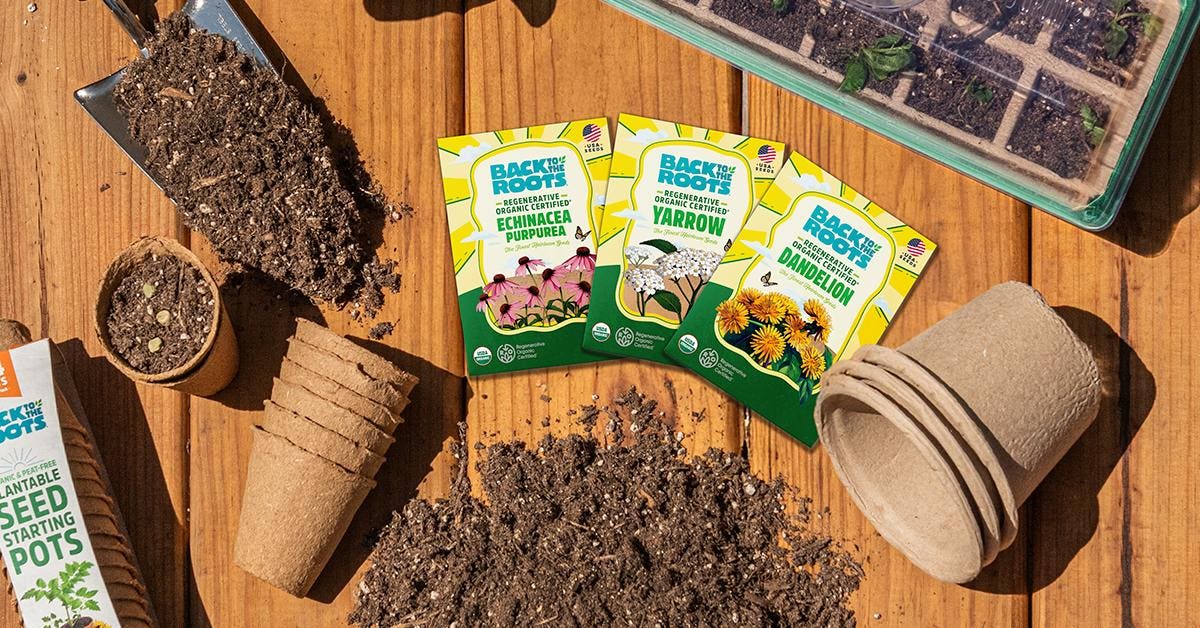
Regenerative Organic Certified seeds have reached mainstream retail for the first time through a partnership between Back to the Roots and Gaia Herbs. The new seed lineup, now available at major retailers including Walmart, Home Depot, and Target, marks a significant expansion of regenerative agriculture beyond specialty grocery stores into the gardening category.
The collection features seven herb varieties sourced from Gaia Herbs’ 270-acre North Carolina farm, including Echinacea, Yarrow, Nettle, Valerian, Dandelion, Elecampane, and Chinese Skullcap. According to Kate Renner, Director of Farm Operations at Gaia Herbs, the collaboration represents the first time ROC-certified seeds have been distributed at scale through mainstream garden centers.
Partnership Rooted in Regenerative Organic Certified Standards
The relationship between the two companies dates back to 2020, when Back to the Roots first sourced Echinacea seeds from Gaia’s farm. However, the timing for a formal ROC seed partnership aligned in early 2024, after Gaia achieved Regenerative Organic Certified status in 2022.
Gaia Herbs has maintained organic practices since receiving USDA Organic certification in 1997. The farm elevated its standards by pursuing ROC certification with guidance from the Rodale Institute, ultimately certifying all 270 acres at the Silver tier by 2022.
The certification process required meeting rigorous standards across three pillars: soil health, animal welfare, and social fairness. According to Renner, the social fairness component prompted the farm to enhance training programs for seasonal workers and commit to maintaining living wages regardless of government minimums.
Market Data Shows Consumer Demand
Industry research suggests consumer appetite for regenerative products is growing rapidly. According to SPINS, Regenerative Organic Certified products are experiencing 21% year-over-year growth, outpacing both labeled Organic products at 16% and Non-GMO products at 13%.
Additionally, the number of consumers purchasing ROC products has increased 30% year-over-year. These shoppers tend to be premium buyers who make frequent purchases and build larger shopping baskets, according to the market data.
PWC’s Voice of the Consumer Survey 2025 indicates that 44% of consumers would pay more for products that improve environmental and land health. Meanwhile, NSF research shows that 85% of consumers trust independent third-party certifications to verify product claims.
Following the Organic Trajectory
The lawn and garden category appears to be following a pattern established by organic food products. Nikhil Arora, co-founder of Back to the Roots, noted that certified organic products now represent approximately 15% of the seeds and soils category in lawn and garden.
However, the growth rates tell a more compelling story. According to Arora, organic seeds are showing three to four times faster per-product velocity growth compared to conventional seeds among major retail partners. Consumers purchasing organic seeds also generate higher overall basket values for retailers.
This momentum in organic products, combined with increasing visibility of regenerative organic certified items in grocery aisles, provided the foundation for bringing ROC standards to the garden category. Arora emphasized that Millennials and Gen Z consumers are driving this shift by prioritizing products that align with environmental values.
Testing Soil Health Through Crisis
The resilience of regenerative practices became evident when Hurricane Helene devastated western North Carolina last fall. While much of Transylvania County experienced severe damage, Gaia Herbs’ farm demonstrated notable resistance to erosion.
According to Renner, despite flooding across the fields, the farm saw minimal sediment runoff due to soil penetrability developed through regenerative practices. The incident provided real-world validation of the long-term benefits associated with regenerative agriculture methods.
Jayme Torres, who leads Gaia’s commercial operations, noted that soil health has become a central conversation in the company’s retail partnerships. Ashley Walgren, Gaia’s social impact and sustainability lead, emphasized that regeneration represents more than certification, describing it as a relationship the company has maintained since 1987.
Mainstream Distribution Strategy
By placing regenerative organic certified seeds at mass-market retailers rather than limiting distribution to specialty stores, Back to the Roots is making the certification accessible to consumers who may be encountering it for the first time. The strategy reflects confidence that mainstream shoppers are ready for premium garden products with verified environmental standards.
Torres observed that major retail partners are increasingly investing in consumer education around regenerative agriculture. This creates natural partnerships that extend from the food aisle through supplements and now into the garden section, she explained.
At Expo West next week, Gaia Herbs plans to distribute Back to the Roots seed packets from their booth. Renner described seeds as symbols of hope that carry the farm’s regenerative practices forward, expressing optimism that collaboration across channels and brands will help the regenerative movement expand. The success of this retail partnership will likely influence whether other regenerative organic certified products attempt similar mainstream distribution strategies in the coming months.