





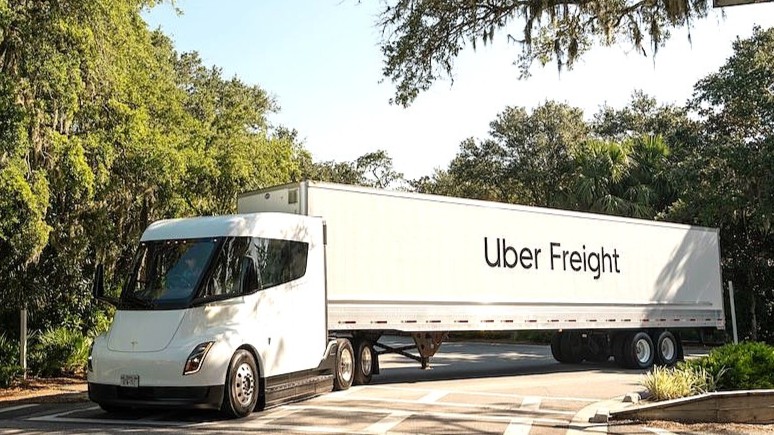
Uber Freight posted flat fourth-quarter revenue and a slight decline in gross bookings as the division continued to navigate a prolonged downturn in the North American trucking market, even as the parent company delivered record profitability across its broader platform. The logistics segment generated $1.27 billion in gross bookings for the three months ended December 31, down approximately 1 percent year over year, while freight revenue remained essentially unchanged at $1.27 billion, according to Uber Technologies.
San Francisco-based Uber Technologies released its quarterly financial report and held a conference call with analysts on Tuesday before the market opened. Despite the muted performance, company officials said the freight business reached breakeven profitability during the quarter for the first time in more than three years.
Uber Freight Achieves Breakeven Amid Market Challenges
Chief Financial Officer Prashanth Mahendra-Rajah told analysts that Uber Freight achieved breakeven adjusted EBITDA for the first time in over three years despite a continued challenging operating backdrop. He attributed the improvement to operational discipline rather than stronger pricing, signaling that carriers may continue to face rate pressure in early 2026 while shippers retain leverage in contract negotiations amid abundant capacity.
The freight unit’s operating loss narrowed to $18 million compared with a $41 million loss a year earlier, reflecting cost controls and operational improvements even as demand remained muted. However, the segment remains materially less profitable than Uber’s core mobility and delivery businesses.
Record Quarter for Uber’s Overall Platform
Meanwhile, Uber’s overall platform delivered a record quarter with total gross bookings climbing 22 percent year over year to $54.1 billion. The strong performance was driven by double-digit growth in both mobility and delivery segments, while adjusted EBITDA surged 35 percent to $2.5 billion.
Additionally, Uber operates three distinct platforms: Uber for ride-hailing, Uber Freight for logistics, and Uber Eats for food and goods delivery. The stark contrast between freight performance and the company’s other divisions underscores the ongoing challenges in the North American trucking industry.
Autonomous Vehicles as Long-Term Growth Strategy
While freight demand remains under pressure, Uber executives pointed to autonomous vehicles as a longer-term lever that could reshape the freight unit’s economics. Chief Executive Officer Dara Khosrowshahi said autonomous vehicles represent a significant growth opportunity that could ultimately strengthen the freight and logistics business by driving much higher vehicle utilization.
Khosrowshahi told analysts that autonomous vehicles will unlock a multi-trillion dollar opportunity for Uber Technologies. He explained that having delivery and freight as part of the logistics ecosystem gives the company an opportunity to use these vehicles at a structurally higher utilization than anyone else.
With autonomous operations expected to be live in 15 cities by the end of the year, integrating freight and delivery into Uber’s broader logistics ecosystem could allow autonomous vehicles to stay productive for more hours each day. This approach aims to lower unit costs over time and position Uber Freight to benefit as autonomous technology scales.
Industry-Wide Trucking Market Pressures
In contrast to the optimism around future technology, current market conditions remain challenging. Uber did not break out shipment volumes or truckload-specific metrics, but the flat performance of its freight unit mirrors broader industry trends in the trucking sector.
North American trucking markets remained oversupplied through most of the fourth quarter, with spot rates under pressure and contract pricing still resetting lower. These market dynamics have created a difficult environment for freight brokers and carriers alike.
While Uber issued consolidated guidance for the first quarter of 2026—forecasting gross bookings of $52 billion to $53.5 billion and adjusted EBITDA of up to $2.47 billion—the company did not provide segment-specific outlooks for freight. Executives emphasized continued investment discipline and platform efficiency heading into 2026, suggesting Uber Freight will focus on maintaining margins and positioning for an eventual market rebound rather than pursuing volume growth in the current challenged environment.