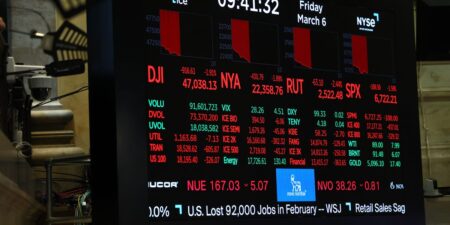





A significant market rotation is underway in 2026, with investors shifting their focus away from technology stocks toward HALO stocks, according to the framework’s creator. The term HALO, which stands for “heavy asset, low obsolescence,” describes companies with substantial physical capital and durable economic relevance that are expected to outperform asset-light businesses like software makers.
Josh Brown, CEO of Ritholtz Wealth Management, coined the HALO framework in early February to describe a market rotation that was already taking place. Brown told Business Insider that while the recent AI-driven concerns have accelerated this trend, Wall Street firms are misunderstanding the fundamental nature of the shift.
Tech Sector Faces Sharp Decline
The technology sector has entered negative territory since the start of 2026, with software companies bearing the brunt of the selloff. According to market data, the State Street Technology Select Sector ETF is down 5% year-to-date, while the iShares Expanded Tech-Software Sector ETF has plunged 17%.
This downturn comes despite software companies generally reporting strong earnings results. Brown explained that the stock market’s internal logic today has shifted away from real-time company performance toward evaluating whether businesses are susceptible to or immune from AI disruption.
Understanding the HALO Framework
Brown suggests that asking whether a chatbot or large language model can replicate what a company sells serves as a good indicator of whether a stock fits the HALO framework. However, he emphasized that AI susceptibility is not the only factor investors should consider.
Meanwhile, sectors that align with the HALO investment strategy have significantly outperformed the broader market. Energy, materials, and industrials sectors have posted gains this year, marking a sharp contrast from recent years when technology dominance drove the bulk of market returns.
Wall Street’s Response to HALO Stocks
The HALO framework has captured attention from major financial institutions, including Goldman Sachs, JPMorgan, and Morgan Stanley. Additionally, these firms have begun incorporating HALO concepts into their investment strategies and client recommendations.
However, Brown told Business Insider that while Wall Street’s interpretation is generally on the right track, it doesn’t fully capture his thesis. He views the HALO trade as more than just another cyclical rotation or anti-AI play.
A Fundamental Regime Change
According to Brown, the current market shift represents a distinct regime change that falls outside traditional investment paradigms. He stressed that the rotation cannot be explained simply as old versus new, growth versus value, defensive versus cyclical, or small versus large cap stocks.
Brown explained that since the global financial crisis in 2008, investors have consistently favored asset-light companies that don’t require significant investment in physical infrastructure. In contrast, the HALO era represents a complete reversal of this preference.
The investing professional outlined that the market now prizes companies possessing heavy assets and physical infrastructure on their balance sheets. This includes equipment, land, and facilities with logistics capabilities that were previously viewed less favorably by growth-focused investors.
Market participants will be watching to see whether this rotation into HALO stocks continues or if technology companies can regain investor favor. The sustainability of this trend remains uncertain as companies report quarterly earnings and AI developments continue to evolve.