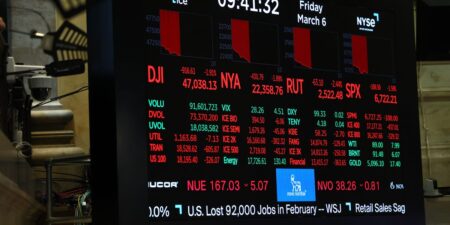






US stocks tumbled on Friday as investors reacted to a shocking February jobs report that showed unexpected job losses amid growing concerns about inflation from surging oil prices. The February jobs report revealed the US economy lost 92,000 jobs, a sharp departure from economist forecasts that predicted 55,000 new payroll additions. The unemployment rate climbed to 4.4%, signaling further weakness in labor market conditions.
The Dow Jones Industrial Average fell 453 points, or 1%, closing at 47,501.55. Meanwhile, the S&P 500 dropped 1.33% to finish at 6,740.02, and the Nasdaq Composite declined 1.59% to 22,387.68. The poor performance reflected investor anxiety about economic conditions as multiple headwinds converge.
February Jobs Report Shows Deteriorating Labor Market
The disappointing employment data comes after a year marked by significant layoff announcements, particularly in the technology sector. Companies like Block recently announced major workforce reductions. Healthcare, typically a strong hiring sector, unexpectedly lost 28,000 jobs last month, though this figure was affected by a strike involving Kaiser Permanente hospital system workers.
According to Jeff Schulze, head of economic and market strategy at ClearBridge Investments, the February jobs data creates a highly negative outlook for the labor market. “Today’s release puts the Fed between a rock and a hard place as the labor market remains at stall speed but inflationary pressures are building,” he said.
Oil Prices Surge Amid Iran Conflict
Additionally, oil prices continued their sharp ascent as the US-Iran conflict escalates, adding to economic uncertainty. Brent crude spiked 9% to above $92.80 per barrel, while US oil jumped 12% to around $91. Gas prices at the pump have already increased this week, according to the report.
The combination of rising energy costs and weakening employment has sparked fears of stagflation among investors. This economic scenario involves sluggish growth alongside rising inflation, a particularly challenging environment for policymakers and markets.
Technology Sector Layoffs Continue
Brad Conger, chief investment officer at Hirtle Callaghan, noted that while artificial intelligence may not be directly replacing jobs, layoffs are funding companies’ new AI expansions. “Block’s decision to lay off 40% of its workforce is a sign of the job bloat in the economy,” he stated.
However, some analysts offered more tempered assessments of the jobs data. Brad Smith, a portfolio manager from Janus Henderson, acknowledged the pain of the February jobs report for markets but suggested the data may not fully reflect underlying trends. “While a negative sign for the labor market narrative, there are one time events in the month that make the print less useful,” he noted.
Economic Challenges Mount for Federal Reserve
In contrast to previous periods when weak employment data might have prompted expectations for interest rate cuts, the current environment complicates the Federal Reserve’s policy options. The report indicates that wage growth came in 10 basis points ahead of expectations, adding to inflationary pressures from elevated oil prices.
Smith pointed out that labor strikes, adverse weather, and benchmark methodology revisions all cloud the signal from this single data point. Nevertheless, even averaging January’s stronger employment numbers with February’s losses reveals a labor market that appears tepid and below replacement levels, he observed.
Market participants will closely monitor upcoming economic data releases and Federal Reserve communications for signals about potential policy responses to the deteriorating labor market conditions. The central bank faces difficult choices as it attempts to balance inflation concerns against employment weakness in the coming months.