




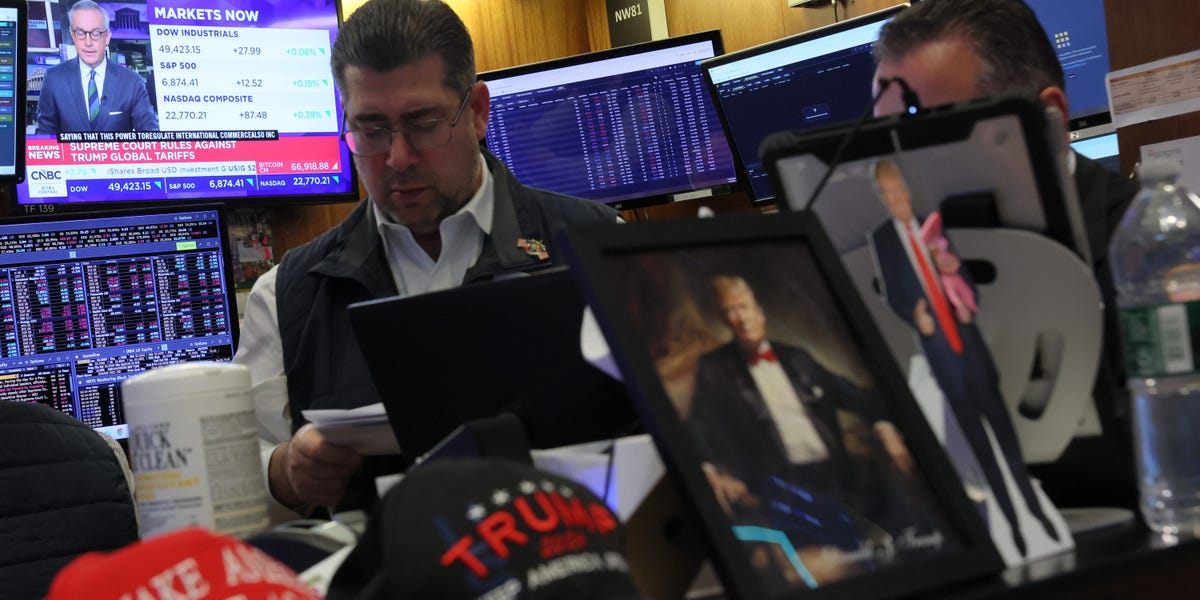
US stocks rallied on Friday following a Supreme Court decision declaring President Donald Trump’s sweeping tariff program illegal. The unexpected ruling on the controversial trade policy sparked a sharp market reversal, with major indexes erasing earlier losses as investors cheered the decision’s potential impact on corporate earnings and economic uncertainty.
The Supreme Court struck down the comprehensive tariff framework that Trump unveiled in April of the previous year, according to market reports. The decision represents a significant legal setback for the administration’s trade agenda, which has been a primary source of market volatility throughout the past year.
Market Response to Trump Tariffs Ruling
Equity markets surged immediately following the announcement, with traders interpreting the Supreme Court decision as favorable for corporate profitability in the near term. “The market just totally erupted,” Jose Torres, a senior economist at Interactive Brokers, told Business Insider. “In the short run, it’s good for corporate earnings.”
The positive momentum overshadowed disappointing economic data released the same day. GDP growth registered just 1.4% year-over-year last quarter, falling short of economist estimates, while the PCE inflation index rose 0.4% in December, exceeding the anticipated 0.3% gain.
Administration Response and Alternative Options
Members of the Trump administration have indicated they possess numerous alternative methods to implement tariffs despite the Supreme Court setback. Matthew Ryan, head of market strategy at financial services firm Ebury, noted that while near-term disruption is possible, the president’s long-term tariff strategy may persist through different legal mechanisms.
Additionally, investors are monitoring the possibility of corporate stimulus if the US government refunds tariffs already paid by American companies. According to Michael Brown, a senior research strategist at Pepperstone, this potential refund scenario has added to market optimism.
Analyst Caution on Long-Term Implications
However, some market strategists warn that investor enthusiasm may be premature. Brown characterized the ruling as a “blow” to the administration but emphasized that Trump likely will pursue alternative avenues to impose trade restrictions. “I think in the grand scheme of things, from a tariff perspective, nothing is likely to change particularly much,” he told Business Insider.
Meanwhile, the stock market rally comes as equities have been struggling to escape a recent malaise. Torres pointed to the sell-off that had spread from the software sector to insurance and real estate industries. “Investors really said, ‘Oh wow. This is materially great for stocks, so let’s try to push the market higher,'” he explained.
Uncertainty Surrounding Trade Policy Implementation
The Supreme Court decision on Trump tariffs raises new questions about how the administration will advance its protectionist trade agenda. While the ruling eliminates the current tariff framework, it does not necessarily prevent future trade restrictions implemented through different legal authorities or congressional action.
In contrast to the market’s optimistic response, the broader economic picture remains clouded by slower-than-expected growth and persistent inflation pressures. The combination of weak GDP data and elevated PCE readings suggests the Federal Reserve may face continued challenges in balancing its dual mandate of price stability and maximum employment.
The administration has not yet specified which alternative methods it will employ to replicate the tariff regime or provided a timeline for new trade policy announcements. Market observers expect further clarification from the White House regarding its next steps, though the timing and scope of any new tariff approach remain uncertain.