




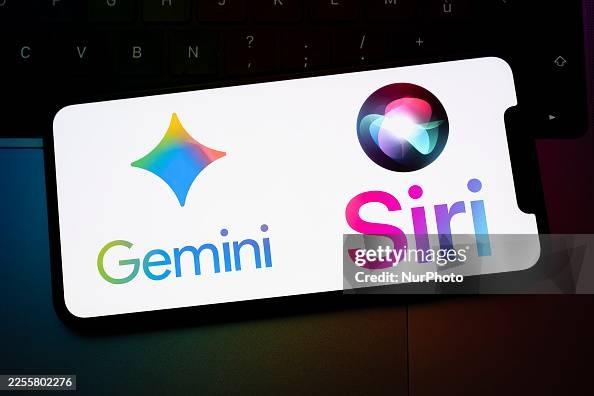
Apple announced a multiyear partnership with Google on January 12 to integrate Gemini models into Apple Intelligence and Siri, marking a significant strategic shift for the iPhone maker. According to Bloomberg, the Apple-Google AI partnership will cost Apple approximately $1 billion annually as the company seeks to revitalize its struggling artificial intelligence offerings. The deal comes after years of internal AI development setbacks and mounting investor skepticism about Apple’s ability to compete in the rapidly evolving AI landscape.
The collaboration will fundamentally reshape Siri by replacing its existing framework with Google’s advanced Gemini technology, according to a joint statement from both companies. Apple shares have declined roughly 5% since the start of 2026, while Alphabet’s market cap surpassed Apple’s for the first time since 2019, according to CNBC reporting from January.
Years of AI Setbacks Drive Partnership Decision
Apple’s decision to partner with Google follows a troubling pattern of artificial intelligence failures that eroded investor confidence. Project Titan, the company’s autonomous vehicle initiative, consumed over $10 billion and employed approximately 2,000 people before executives cancelled it in February 2024, according to MacRumors. Employees internally referred to the project as “the Titanic disaster,” and Apple never publicly demonstrated a working prototype.
Additionally, Apple Intelligence launched with the iPhone 16 in fall 2024 without the conversational Siri features the company had showcased at its Worldwide Developers Conference months earlier. Core capabilities including personal context awareness and in-app actions failed to materialize, and Apple eventually admitted the delay in March 2025. Class action lawsuits followed, alleging false advertising, and the company pulled its Bella Ramsey television advertisement promoting the unreleased features, according to ClassAction.org.
Meanwhile, Google’s AI efforts gained momentum. Alphabet stock surged 65% over 2025 while Apple managed roughly 9% gains, according to Yahoo Finance. Google’s Gemini 3 model launched to strong industry reviews, creating a stark contrast with Siri’s continued limitations.
How the Apple-Google AI Partnership Works
The partnership addresses Apple’s AI credibility gap by leveraging Google’s proven technology while maintaining Apple’s privacy framework. According to TechCrunch and MacRumors, the next generation of Siri will run Gemini through Apple’s Private Cloud Compute infrastructure, ensuring user data remains within Apple’s established privacy protocols. Morningstar analyst William Kerwin told The Verge that this architecture should allow Apple’s privacy reputation to remain intact.
However, the deal represents more than a technology licensing agreement. In December, Apple installed Amar Subramanya as its new head of AI, who previously worked on Gemini at Google. The company also moved Siri development under Mike Rockwell, who successfully launched the Vision Pro headset.
Wedbush analyst Dan Ives characterized the partnership as providing Apple with “a stepping stone to accelerate its AI strategy into 2026 and beyond,” according to Fortune. He called it a “major validation moment for Google” while noting the arrangement benefits both companies strategically.
Distribution Advantage Meets Technical Capability
Futurum Group analyst Daniel Newman described 2026 as a “make-or-break year” for Apple, according to Fortune reporting. The company maintains a massive distribution advantage with 1.5 billion active iPhones globally, but lacked a competitive conversational AI engine to capitalize on that installed base.
In contrast to building proprietary AI models from scratch, Apple is recognizing that the underlying model layer is becoming commoditized. The strategic value lies in seamless integration within the iOS ecosystem rather than foundational AI research, industry observers note.
Spring Launch Creates Near-Term Catalyst
iOS 26.4 is expected to launch in late March, according to multiple sources including 9to5Mac and Bloomberg. This update will reportedly deliver the large language model-based Siri that Apple first promised at WWDC 2024, featuring personal context awareness, on-screen understanding, deeper per-app controls, and natural multi-turn conversations.
Apple CEO Tim Cook confirmed on a recent earnings call that the upgraded Siri remains on track for 2026 release. Internal code leaks analyzed by Macworld show active development advancing toward the spring timeline.
The consensus Wall Street price target for Apple stands around $288, representing approximately 10% upside from current levels near $260, according to Capital.com. Apple currently trades at a premium valuation exceeding 31 times 2026 earnings, according to Seeking Alpha, though that multiple has compressed as AI enthusiasm shifted toward competitors.
Skepticism Creates Opportunity for Investors
Investor expectations for Apple’s AI capabilities have reached generational lows. Raymond James downgraded the stock this month, arguing that significant gains will prove difficult in 2026, according to CNBC. The class action lawsuit over Siri feature delays has a hearing scheduled for January 2026.
Nevertheless, depressed expectations may create an asymmetric opportunity for investors willing to bet on successful execution. Apple does not need to build the industry’s most advanced AI, but rather deliver a functional version that integrates seamlessly within its ecosystem. The Google partnership provides the technical foundation that internal development efforts failed to produce.
The iOS 26.4 public demonstrations scheduled for March will provide the critical test of whether Apple can deliver on its revised AI promises. If the upgraded Siri demonstrates meaningful improvements over its current capabilities, the credibility gap that has weighed on the stock may close more rapidly than current valuations reflect, particularly given the company’s unmatched distribution reach across its device ecosystem.