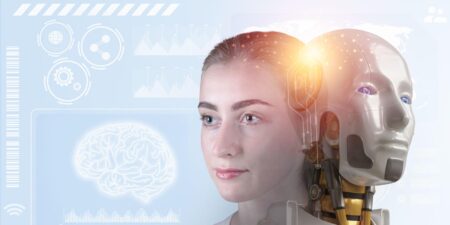






A groundbreaking new essay exploring artificial intelligence and future technological transformation has emerged from researchers Alex Wissner-Gross and Peter Diamandis, offering detailed predictions about how AI will reshape society over the next decade. The comprehensive work, titled “Solve Everything,” presents vivid scenarios of life in 2026, 2030, and 2035, positioning artificial intelligence advancement as the catalyst for what the authors call the Intelligence Revolution. The essay challenges readers to envision concrete changes rather than abstract concepts about AI’s impact.
According to the authors, the exponential progress curve in artificial intelligence has reached a critical inflection point. They describe this moment as “living in the vertical asymptote now,” where fundamental decisions about AI infrastructure are establishing path dependencies that will define the next century.
The Industrial Intelligence Stack and Cognitive Economics
The essay introduces several new concepts to frame the artificial intelligence transformation. Chief among these is the Industrial Intelligence Stack, which Wissner-Gross and Diamandis position as the foundational framework for harnessing AI capabilities. Additionally, the authors propose that Return on Cognitive Spend, or RoCS, is replacing traditional financial metrics like EBITDA as the primary measure of organizational viability.
This shift reflects a fundamental reordering of corporate priorities, according to the essay. Companies can no longer rely on conventional business models but must demonstrate that computational resources generate measurable intelligence units to remain competitive.
Healthcare and Energy Transformations
The essay paints specific scenarios across multiple sectors. In healthcare, the authors envision “Bio-Fabs” where patients receive replacement organs without waiting lists or anti-rejection medications. One example describes a Tokyo patient receiving a scheduled transplant of a printed, autologous kidney replacement within three days, with the authors characterizing organ shortages as merely “an inventory management error.”
Meanwhile, energy systems undergo equally dramatic changes in their vision. The essay describes AI controllers managing fusion plasma instabilities at microsecond intervals, transforming energy from a constraint into what the authors call “a routing issue.” These intelligent systems would clear urban air pollution through optimized energy distribution and usage.
Four Revolutionary Waves
Wissner-Gross and Diamandis contextualize current artificial intelligence development within a framework of four historical revolutions. The Scientific Revolution represented a war on ignorance, while the Industrial Revolution targeted physical labor constraints. The Digital Revolution eliminated distance barriers through connectivity.
However, the Intelligence Revolution now underway constitutes “a war on Attention,” according to the researchers. Each revolution required what they term a “harness” – the Scientific Method harnessed truth, Factory Discipline harnessed labor, and Operating Systems harnessed computation. The Industrial Intelligence Stack serves as the harness for AI capabilities.
The essay emphasizes how these harnesses enable new institutional structures. Historical examples include scientific journals, corporations, and internet protocols. Contemporary equivalents involve Abundance Targets and Outcome-Based Contracts, which the authors suggest will fundamentally alter commerce, law, and medicine.
Societal Implications and Adaptation
Throughout the work, Wissner-Gross and Diamandis employ a distinctive rhetorical technique, reframing monumental challenges as administrative problems solved by advanced artificial intelligence systems. This approach illustrates their central thesis that AI capabilities will transform life-or-death issues into routine logistics.
The essay acknowledges the difficulty many face in envisioning such rapid change. While people intellectually understand that AI and robotics will transform society, concrete visualization remains challenging. The authors aim to bridge this gap through detailed, time-specific scenarios rather than vague predictions.
The work also draws parallels to past technologies that transitioned from science fiction to mundane reality. Video calling, once depicted in Dick Tracy comics as futuristic fantasy impossible with 1980s technology, became commonplace through smartphones and internet connectivity. Similarly, the essay suggests current AI predictions will materialize through incremental technological advancement rather than sudden breakthroughs.
The essay remains available online for public access, though the authors have not announced plans for expanded publication or formal academic peer review. As artificial intelligence development continues accelerating, such forward-looking analyses may help individuals and organizations prepare for transformative changes, though specific timelines and outcomes remain uncertain.