





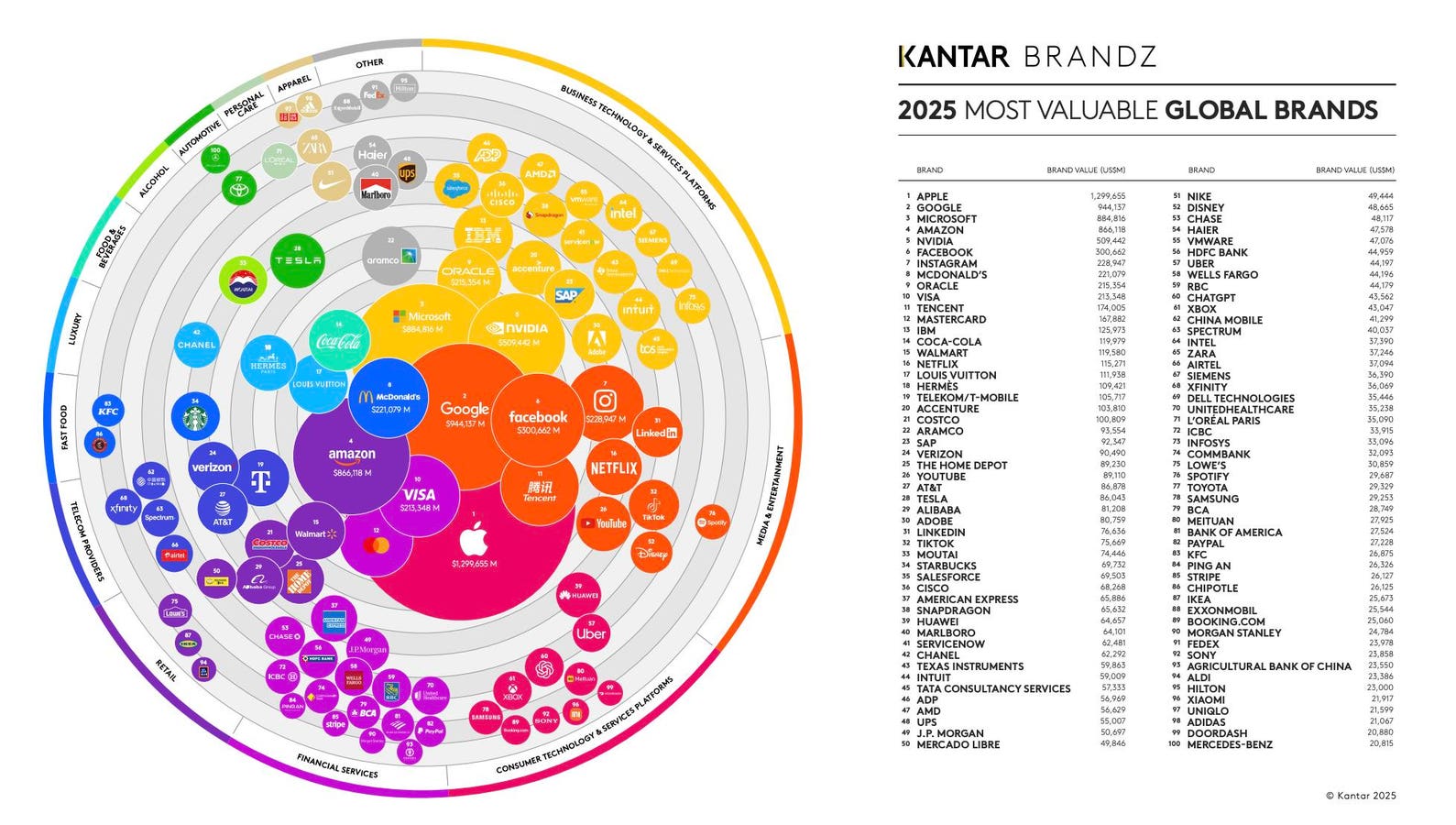
As artificial intelligence erodes traditional competitive advantages across industries, brand equity has emerged as the most durable strategic asset companies can leverage. Recent research spanning two decades demonstrates that strong brand building delivers superior financial returns that AI tools alone cannot replicate, according to Kantar’s 20th anniversary BrandZ ranking of the Most Valuable Global Brands.
The Global Top 100 brands reached a record $10.7 trillion in total value, representing a 29% year-over-year increase, according to the report. Apple maintains the top position for the fourth consecutive year at $1.3 trillion in brand value alone, up 28% from 2024, followed by Google at $944 billion, Microsoft at $885 billion, Amazon at $866 billion, and Nvidia at $509 billion.
Why Brand Equity Matters in the AI Era
The rise of AI has created what researchers call a “commoditization paradox.” While conventional wisdom suggests AI provides competitive advantage to early adopters, MIT Sloan Management Review recently challenged this assumption. Researchers David Wingate, Barclay Burns, and Jay Barney argued that AI will become “a source of homogenization” rather than differentiation as algorithms, training data, and hardware become increasingly accessible.
This prediction has already proven accurate. In June 2023, OpenAI’s Sam Altman dismissed the possibility that a small team with modest resources could build a competitive large language model. However, Chinese AI startup DeepSeek accomplished exactly that within two years on a limited budget, demonstrating how quickly technical moats can erode.
The Financial Performance of Strong Brands
Brand equity delivers measurable financial advantages that extend beyond marketing metrics. From 2006 to 2025, the Kantar BrandZ Strong Brands Portfolio delivered 435% cumulative share price growth, compared to 353% for the S&P 500 and just 171% for the MSCI World Index, according to Kantar analysis.
Additionally, strong brands demonstrated superior resilience during economic crises. During both the 2008 financial crisis and the COVID-19 pandemic, the strongest brands experienced smaller declines, faster recovery periods, and ultimately achieved higher valuations than market indices.
The data reveals another striking pattern. Brands that disrupted their categories or reinvented themselves accounted for 71% of the incremental $9.3 trillion in value created in the Global Top 100 since 2006, indicating that innovation and brand building function as complementary rather than separate strategies.
Measuring Brand Value Through Certified Frameworks
In January 2025, the Marketing Accountability Standards Board certified Kantar’s Meaningful Different Salient framework, independently validating its connection between brand metrics and financial performance. The MDS framework comprises seven metrics derived from 4.5 million consumer interviews across 54 markets covering 22,000 brands in 538 categories.
Meanwhile, Kantar’s Blueprint for Brand Growth, built on analysis of 6.5 billion consumer data points over a decade, found that brands meaningfully different to more people command up to five times higher market penetration compared to brands low in meaningful difference. These brands can also justify up to twice the average category price point.
Three Growth Accelerators for Building Brand Strength
The Blueprint identifies three evidence-based levers that drive measurable growth. First, predisposing more people through creativity, advertising, and experiences drives nine times higher volume share and four times higher likelihood of growing future market share when optimally executed.
Second, being present across more buying occasions through optimized distribution and customer journey management enables brands to win seven times more buyers than those present in only half of purchase situations. Third, finding new space through incremental motivations and occasions doubles a brand’s chance of growth, with a 10% increase in usage occasions resulting in 17% revenue growth, according to the research.
The ChatGPT Example and First-Mover Advantage
OpenAI’s ChatGPT debuted in the BrandZ Global Top 100 at position 60 in May 2025 with an estimated brand value of $44 billion, making it the highest-valued newcomer since Nvidia in 2021 and the youngest company ever to make the list. However, the report includes a cautionary note that with generative AI competition accelerating, OpenAI will need to invest in its brand to preserve its first-mover momentum.
In contrast, established technology companies have demonstrated the staying power of strong brands. U.S. brands now comprise 82% of the total value of the Global Top 100, up from 63% in 2006, while European brands declined from 26% to just 7% over the same period.
Martin Guerrieria, Head of Kantar BrandZ, emphasized that “even through economic crises, the world’s most valuable brands have consistently outperformed the S&P 500 and MSCI World Index over 20 years.” This performance gap of 264 percentage points over two decades represents the difference between doubling an investment and quintupling it.
As AI capabilities continue to converge across competitors, companies face a strategic choice: redeploy AI efficiency gains toward strengthening brand equity or treat AI purely as a cost-reduction tool. The evidence suggests that sustained competitive advantage in an AI-first world will depend less on technological capabilities and more on the irreplicable relationships brands build with consumers over time.